
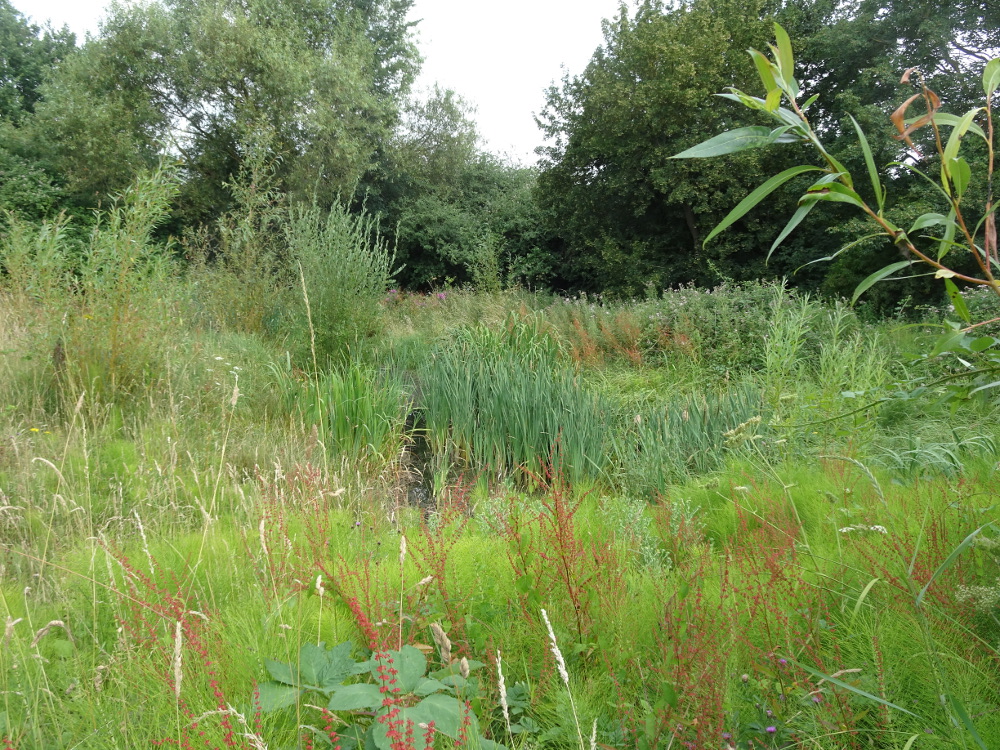
How did our pond get polluted?
Sadly, the pond at Swaines Green was polluted when a major sewage spill occurred in February – see Major pollution incident at the pond.
It seems that there was a chain of mishaps leading to this calamity.
First of all, the pond was created some 15 years ago, and whilst it was inadvisable to place it next to, and below, a sewage manhole cover, it was otherwise a good location for a pond, and it is possible that when it was instated nobody realised there was a manhole cover under the brambles and other growth – even conservation volunteers cutting right on that spot a few months ago didn’t know it was there.
Then Thames Water was called to clear a blockage for the residents on the Coronation Hill spur, and they elected to try to force the blockage through. Unfortunately they didn’t have this manhole marked on their maps.
Even so, it might have been all right had there not been another blockage in the pipeline downstream, under the fields beyond Swaines Green, which now appears to be caused by tree roots, so the forcing through created too much pressure for the manhole cover to take.
So, what next?
Removing the pollution and restoring the habitat is quite complex and needs to be done with care. After discussion with the Head Keeper of City of London, we understand that the current state of plans is as follows.
Firstly, Harris fencing (aka HERAS fencing – like that between Forties Field and the Thatch Cottage) has been installed around the pond. It is planned to add newt fencing which will stop amphibians from trying to get into the pond to breed.

Then Thames Water needs to ensure that the blockages downstream are cleared, and they will be addressing that in the next few days. That will enable the pond to be pumped out, back into the sewer. This will need to be done slowly and carefully, with a filter on the pump inlet and an ecologist from the City of London present to ensure any creatures still living in the pond are captured and dealt with appropriately. They hope to be able to do this on or before 19th March. It is possible that this pumping may need to be repeated as water builds up after rain.
Then the contaminated soil will be removed from the pond and from the bank, and the pond will be given a new clay liner. At this point it is ready for the restoration plan to be put into effect.
The details of this restoration plan are still being formulated. It is expected to include Froglife, a UK charity concerned with the conservation of amphibians and reptiles, to advise on the reintroduction of amphibians. There may also be a replanting scheme. All this will take several months, and is also subject to ongoing discussions with Thames Water as to the extent of their involvement. As soon as a restoration plan is agreed, then City of London will make a media release.
So there we are, a long road back but hopefully it will eventually be even better than before!