
Wildlife
To date, 2022 has proved to be a warmer than average year, with no prolonged cold spells, but a predominantly dry one. Indeed, as spring gave way to summer, the rain became less and less, and by July we have drought conditions.
This has meant that the breeding season has been quite successful as far as birds are concerned, and insects also seem to be plentiful. It remains to be seen how the drought affects things in the second half of the year.
There were 20 usable nestboxes this year, 19 of which were tit type boxes, and one suitable for a Jackdaw, Stock Dove or Little Owl – this one was however again used by a squirrel.
Of the tit boxes, 12 were used by Blue Tits and 6 by Great Tits. Two of the Blue Tit and one of the Great Tit nests failed, all believed due to predation. Of the remainder, the five Great Tit broods fledged 26 young, and the ten Blue Tit broods fledged at least 55 young. One Blue Tit nest contained only three eggs, just two of which hatched and successfully fledged; another had nine eggs but some disaster befell them – maybe one parent died? – and just two fledged. On the other side of the coin, the largest successful broods were ten Blue Tits and nine Great Tits. Where possible, the young were ringed: a total of 26 Great Tits and 45 Blue Tits.
A partial breeding survey of other bird species indicated that species like Blackcap, Chiffchaff, Wren and Dunnock were present in similar numbers to last year. It seemed however that there were fewer singing male Robins, Blackbirds and Song Thrushes were a little down – probably due to last year’s poor breeding season. No Whitethroats, Garden Warblers or Lesser Whitethroats were found this year. Of the finches, we had similar numbers of Chaffinches, Greenfinches, Goldfinches and Linnets as last year, but once again no Bullfinches.
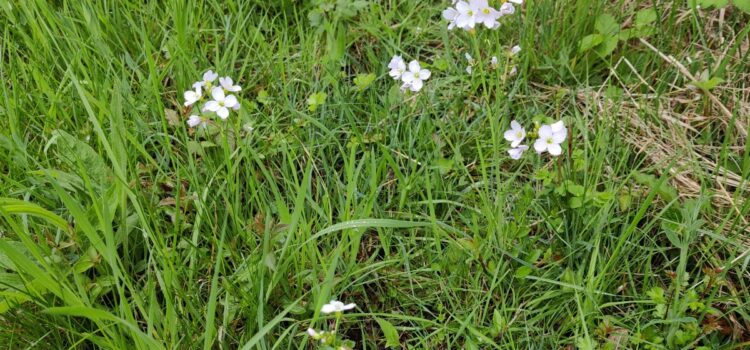
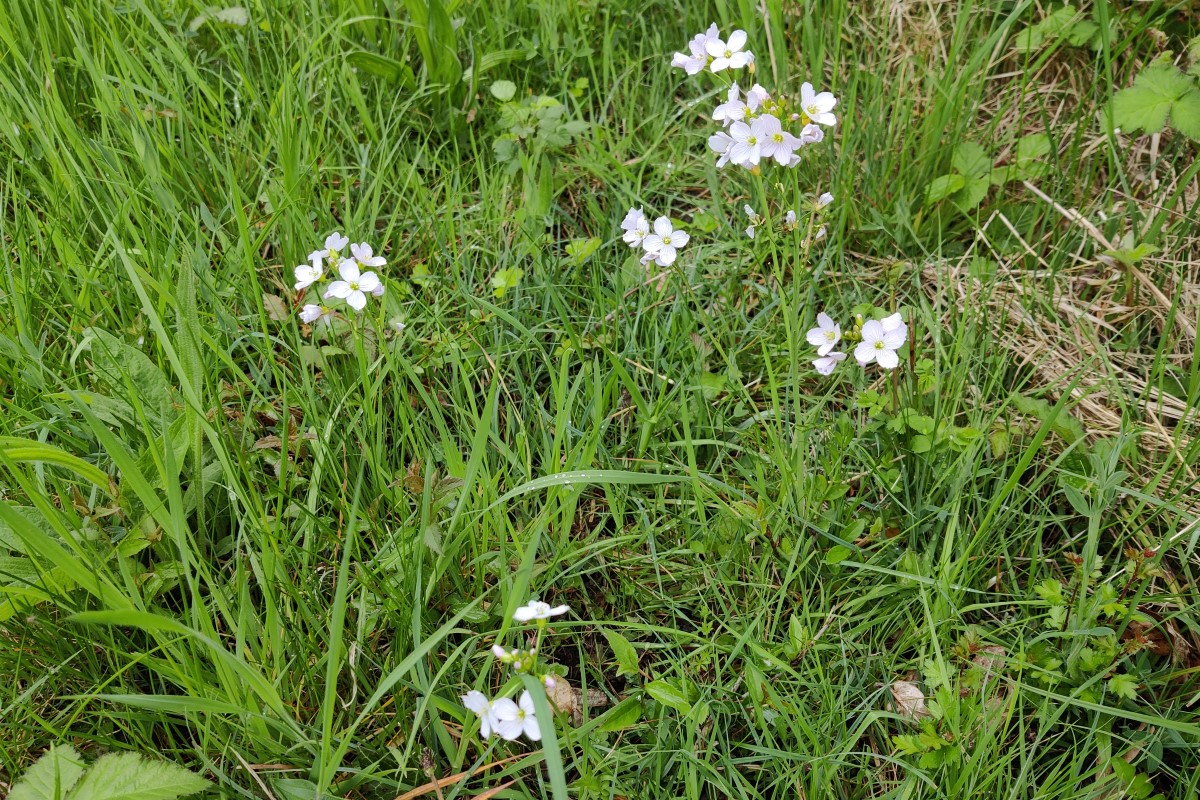
The wildflowers bloomed well again this spring and early summer – the number of Lady’s Smock (also known as Cuckoo Flower) seem to be increasing in Middle Lincoln’s Field – but it remains to be seen what effect the worsening drought exacerbated by the extreme heat in July has had on our plants. It is already clear that some are suffering.
The butterflies however seem to be doing well. There has been no formal survey, but the usual species have been seen in good numbers. At time of writing, flights of Meadow Brown, Ringlet and Gatekeeper are showing well.
Conservation
Lower Lincoln’s Field has had an extra cut this year: the objective is to cut twice a year so as to limit the growth of grasses and encourage wildflowers, so it was cut in May and will be cut again with the other fields in the autumn.
Meanwhile the pond continues to recover from its pollution with sewage last year. Both Mallard and Moorhen have been seen there since the clean-up. Currently it is empty thanks to the drought – similarly, all our streams have run dry – so the opportunity was taken to reduce the Reed Mace (Bullrushes), which had grown strongly due to the excess nutrients in the pond after the sewage spill and were threatening to take over all the open water. The good news was that some dragonfly nymph skins were found on the rushes, indicating that nymphs had survived in the water and reached adulthood. No other wildlife was found but may have already left due to the lack of water.
Sadly we have to report some vandalism has struck again. A gang of youths spent a couple of days loitering around the bridge between Forties Field and Middle Lincoln’s Field, following which some damage to the bridge was evident and a lot of litter was subsequently removed from the stream beneath. There has also been some damage to the bridge from Forties Field onto Bolt Cellar Lane. Both of these have been drawn to the attention of the City of London wardens and we await news of their plans to repair.
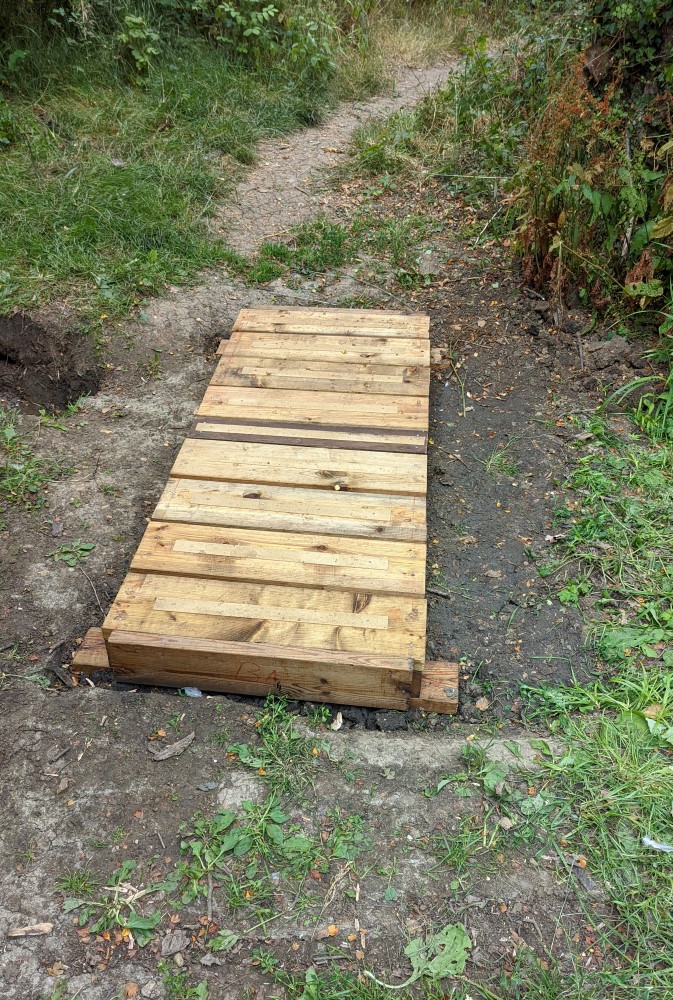
But to end on a more positive note: the winter quagmire that is the stream crossing at the foot of Lovelocks Meadow will hopefully be alleviated. The stream has been routed through a culvert, which has already improved the path, and a boardwalk has now been installed above this. There will still be plenty of muddy paths in winter, but hopefully this particular spot will be more navigable!